All I Want is Snacks W Border for Tshirt: A Practical Design Asset for Print-On-Demand and Creative Workflows
For anyone running a print-on-demand business, building a sublimation product line, or producing custom apparel for clients, the difference between a usable design and a problematic one often comes down to preparation and file structure. The “All I Want is Snacks W Border for Tshirt” digital design is a good example of a specialty asset built with intentional limitations that actually simplify production workflows. Unlike many transparent-background designs that rely on the base garment color to fill negative space, this design features a bordered, non-transparent format with a deliberately white center. Understanding what that means for your production pipeline is essential before you drop it into your next project.
What This Design Is and Why Its Structure Matters
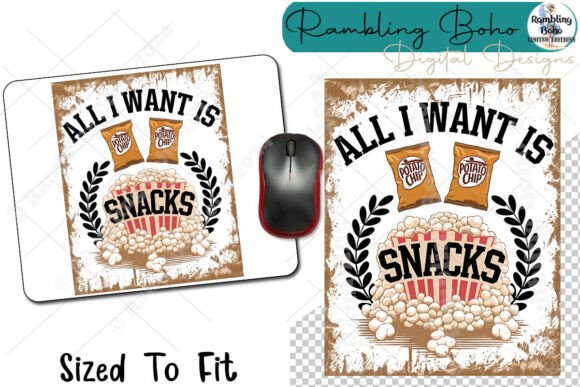
At first glance, “All I Want is Snacks W Border for Tshirt” looks like a playful apparel graphic. But the technical details set it apart. The PNG file has transparent areas around the outside edges, while the interior—the main artwork area—is intentionally white. That means the design includes its own white base layer inside the border, not relying on a white toner or a white underbase from your printer to create contrast on dark garments. For sublimation, this is particularly significant because sublimation ink does not print white. With the white area built in as part of the flattened design, you can transfer the graphic onto white or light-colored polyester substrates and have the white portions appear as intended. On darker substrates, the white interior will show up only if you are printing onto a white-coated surface or using a transfer method that accommodates an opaque layer.
The design comes as both PNG and JPG files at 300 dpi, sized at 12 by 16 inches—a dimension that fits standard adult t-shirts well. Because all elements are manipulated, stacked, and flattened into a single layer, the artist’s composite is preserved exactly as intended. You cannot separate individual pieces after the fact, but for print production, flattening eliminates the risk of shifting layers or missing fonts during export.
Where This Design Fits in a Production Workflow
Incorporating “All I Want is Snacks W Border for Tshirt” into your process depends on where you are in the product development cycle. If you are still in the planning phase, the bordered format gives you a clear visual boundary to work with. The 12 by 16 inch canvas makes it easy to visualize placement on a standard t-shirt without resizing before test printing. You can drop the file into a mockup template immediately and get a realistic sense of how the border frames the artwork on a garment.
For those already past the planning stage and moving into production, this file is ready for direct use in sublimation, DTF (direct-to-film), or standard inkjet printing workflows. Because the PNG includes transparency only around the outer edge, you can place the design over a colored background in your layout software—such as Photoshop, Affinity, or Silhouette Studio—and the border will contain the artwork cleanly. There is no need to create a separate white underbase or knock out background areas manually. The white center is baked in.
If you are working after a project has launched and need to offer size variations or alternate placements, the 300 dpi resolution gives you headroom to scale the design up or down without losing clarity. Resizing within reason—say, shrinking it to 8 by 10 inches for a hoodie or increasing it to 14 by 18 for a larger back print—keeps the artwork crisp. Just remember that the border proportion will scale with everything else, so check your layout before final export.
Software Compatibility and File Handling
One of the practical advantages of this design is its broad software compatibility. The PNG and JPG formats open natively in most graphic and layout programs. If you use Illustrator, you can place the file and use it as a linked or embedded image. In Affinity Photo or Designer, it behaves the same way—simply a high-resolution raster layer. Photoshop users can open it directly and apply color adjustments, curves, or layer effects on top, though because the file is flattened, you will be editing the entire composite rather than individual elements. For users of Silhouette Studio or similar craft software, the design can be imported as a print-and-cut image, provided you position it within the software’s registration mark boundaries.
It is worth noting what this design does not include. There are no cut files, vector files, or individual layered elements. If your workflow depends on separating text from graphics or isolating the border for a special effect, you will need to recreate those elements yourself. The design is intended for direct print output, not for further deconstruction.
Implementation Tips for Different Printing Methods
Sublimation. Because sublimation requires white or light polyester surfaces to show colors clearly, the built-in white center of this design is most effective on white or pastel garments. If you are pressing onto a dark polyester item, the white area will take on the base color of the fabric unless you use a sublimation paper with a white opaque base or print onto a white-coated hard substrate like a ceramic coaster or polyester banner. The bordered format actually helps here—the border defines the artwork area cleanly, so you can align the transfer without guesswork.
DTF (Direct-to-Film). DTF printing applies a white adhesive powder layer during the transfer process, which means even designs without built-in white can show up on dark fabrics. However, the white interior of this design still simplifies the DTF setup because you do not need to add a white underbase in your RIP software. The design already accounts for white areas, so you can send it directly to your DTF printer as-is. Just verify that your printer and film combination handles the white density correctly, since the baked-in white may print differently than a generated underbase.
Standard Inkjet or Laser Print. For those printing on printable transfer paper, the white center will print as unprinted paper if your transfer media is white. On clear or translucent transfer sheets, the white will show the base garment color, which may or may not match your intent. Test on the specific transfer paper you plan to use before running a batch.
Quality Control and Long-Term Use Considerations
Working with flattened, high-resolution designs like this one streamlines quality control because there is less that can go wrong during file handoff. You do not need to check layer visibility, font availability, or linked images. What you see in the PNG preview is what you will print. However, there are a few aspects to check on your end before production.
First, verify the color appearance on your monitor against printed output. The note that colors may vary slightly due to screen settings and printing methods is not boilerplate—it is a real factor when dealing with sublimation inks that shift during the heat press cycle. If color accuracy is critical for branding or client approval, request a proof print before committing to a large run.
Second, because the design is flattened, any adjustment you make globally affects the entire image. Brightening the artwork will brighten the white center as well. If you need to change only the background or only the text, you would be better off finding a layered alternative or building your own version from scratch.
Third, consider file organization for long-term use. The design is delivered as a digital download, which means you are responsible for storing, backing up, and naming the files in a way that makes them retrievable later. A simple folder structure by theme or printing method—for example, “Food-Themed / Sublimation / All I Want is Snacks Bordered”—saves time when you revisit the design months later for a reorder or a new product variant.
Integrating Into Broader Product Lines and Storefronts
If you sell through multiple channels—Etsy, Amazon Merch, Shopify, or your own website—this design can be adapted across platforms without reworking the file. The 12 by 16 size fits most t-shirt templates, but you can also crop or resize it for tote bags, mugs, or phone cases. Just keep the border intact, since it is part of the compositional structure.
From a licensing perspective, this design does not include POD (print-on-demand) licensing by default. That means you cannot simply upload the file to a print provider and sell the design as-is on products. You will need to incorporate it into your own product designs, combine it with other elements, or use it as part of a larger composition. If you operate a POD storefront, check your provider’s licensing policy and consider purchasing a commercial license if necessary.
For those using Creative Fabrica, leaving a review and favoriting the store or listing helps you find the design again quickly. Given that Creative Fabrica rewards reviews with coins, it is also a practical way to reduce future design costs while building a library of tested assets.
Practical Workflow Example
Imagine you are preparing a small batch of tote bags for a weekend market. Your process might look like this:
- Open “All I Want is Snacks W Border for Tshirt.png” in your preferred software.
- Resize the canvas to match your tote bag dimensions, keeping the design centered.
- Add a colored background layer behind the design—perhaps a soft pastel—so the transparent outer edge blends into the bag color.
- Print onto sublimation paper using the correct ICC profile for your printer.
- Heat press onto the polyester tote bag at 400°F for 45 seconds.
- Inspect the transfer. The white interior should remain clean and the border sharp.
This same workflow adapts to t-shirts, aprons, pillow covers, and even quilt squares. The key is that you do not have to rebuild the file for each product type. You simply adjust placement and background color.
Final Observations on Usability
The “All I Want is Snacks W Border for Tshirt” design is a focused asset for creators who value preparation and repeatability. Its bordered, non-transparent format eliminates common production hurdles like missing white underbases or stray transparency artifacts. While it does not offer the flexibility of an editable vector or layered file, it compensates with immediate readiness for print. For anyone who works with sublimation, DTF, or standard transfer methods and wants a design that behaves predictably across substrates, this kind of asset fits naturally into a production-oriented workflow. The trade-off between creative control and production speed is clear, and for many small business owners and print professionals, that trade-off is well worth making.